Bait Finesse System
Bait Finesse System (BFS) was developed in Japan. That much is agreed upon.
I have read that it was developed to catch largemouth bass. Because of intense fishing pressure, bass became harder to catch with traditional lures. Smaller lures and lighter lines were still effective, and could be used in open water. With very light lures, though, existing rods and reels lacked the accuracy necessary for pitching around heavy cover. Manufacturers responded with reels and rods designed specifically to pitch lighter lures.
Although the Bait Finesse System was developed to catch bass, and purists would contend that it is strictly a bass fishing method, anglers in Japan started using BFS reels to fish for trout. Seeing a potential new market, rod manufacturers developed rods specifically designed for the light lines and light lures that BFS reels made possible. Different rods were designed for stocked trout in "areas" (managed pay-to-fish ponds) and wild trout in streams.
However, I have also read that BFS actually was developed to catch trout in streams because anglers who loved their baitcasters needed reels that would cast trout-sized lures. As this account goes, bass anglers later adopted it to finesse fishing for bass.
Which account is correct? I don't know. How we got here is not as important as the fact that we did get here. There are very nice reels that can cast very light lures, and very nice rods designed specifically for those same very light lures. That's really all that matters.
Bait Finesse System for Trout
Lure fishing for trout is quite popular in Japan. Until fairly recently, it was a game limited to spinning rods and reels. However, the availability of Bait Finesse System reels that can cast lures weighing only 1 or 2 grams (1/16 oz or less), rods designed for lures as light as 1 gram and lines as light as 1 lb has opened a new genre of fishing: BFS for trout, also called Mountain Stream Bait Finesse.
Realistically, though, it's not just for trout. A more all-encompassing name would be Ultralight BFS.
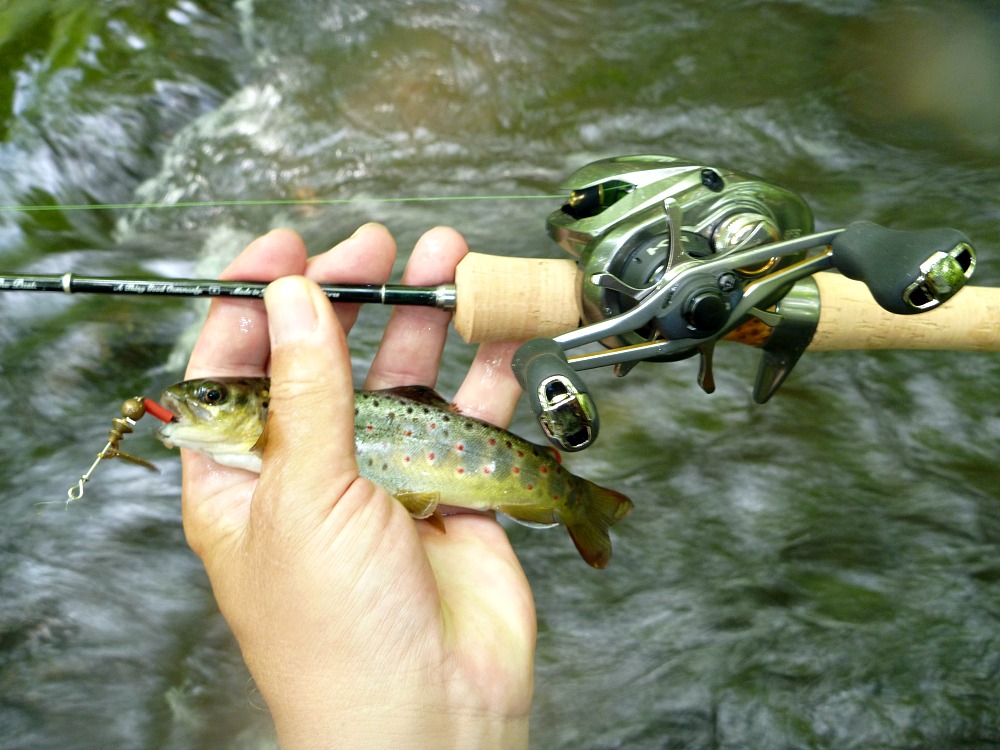 Fishing a Mepps size 0 with a baitcaster
Several years ago, a guy submitted a question on the Question and Answer column of a major outdoors magazine. He wanted to know why trout fishermen don't use baitcasting reels. Most of the guys who answered tried to be helpful but their answers were pretty predictable, along the lines of "most baitcasting reels are designed for heavier line and lures." That was then. This is now. There are now baitcasting reels (and rods) designed specifically for light lines and light lures! Ultralight BFS is a thing!
So why don't trout fishermen use them? Probably because most trout fishermen don't know they exist. Until fairly recently, BFS was known only to bass anglers. Even in Japan, the use of BFS for trout is pretty recent. It has gotten almost no coverage at all in the US. That's why Finesse-Fishing.com was founded: to bring to the US market some wonderful JDM gear, including BFS reels and baitcasting rods designed for trout, whether in alpine lakes or in mountain streams. BFS for trout is in its infancy in the US. We aim to change that!
Although most of my Ultralight BFS fishing is for trout, I have to avoid falling into the trout-centric trap. There is no reason whatsoever that Ultralight BFS rods and BFS reels capable of casting 1 to 2 gram lures couldn't be used for bluegills or crappies or perch or smaller bass. I have only recently learned that there are Japanese anglers who use BFS gear to fish for chubs! I am not talking about the multi-pound chubs that exist in England and Europe, but instead about the 4-7" chubs that exist in warm water streams in Japan. The most popular lures for their "chubbing" ( チャビング ) are micro spoons.
One could ask, and indeed many have, why would you want to use baitcasting gear when spinning gear works so well already, especially for casting light lures. One could argue, and many have, that in skilled hands a baitcaster is more accurate and that it is easier to cast with a low trajectory - under overhanging branches - and also to have the lure land more softly (with more finesse). I have seen videos of Japanese anglers making casts with spinning rods that are just as accurate and with the same low trajectory. Sadly, the feathering that allows Japanese mountain stream spin fisherman to cast that accurately just isn't generally taught in the US.
Realistically, I think the main reason is that some people just love baitcasters and find them to be more fun and more satisfying than spinning reels. And that extends the use of Ultralight BFS rods and reels way beyond mountain streams. How many town parks have ponds or lakes that are full of panfish and smaller bass? Regular BFS gear (ie, intended for bass) would be overkill, but Ultralight BFS? Oh, yeah!
One of my favorite ultralight lures is the Shimano Slim Swimmer 1.5 gram spoon, which is well within the capabilities of the Shimano Calcutta Conquest BFS or the Aldebaran. Still, they are small enough and slim enough for even fair sized sunfish (or creek chubs) to take them.
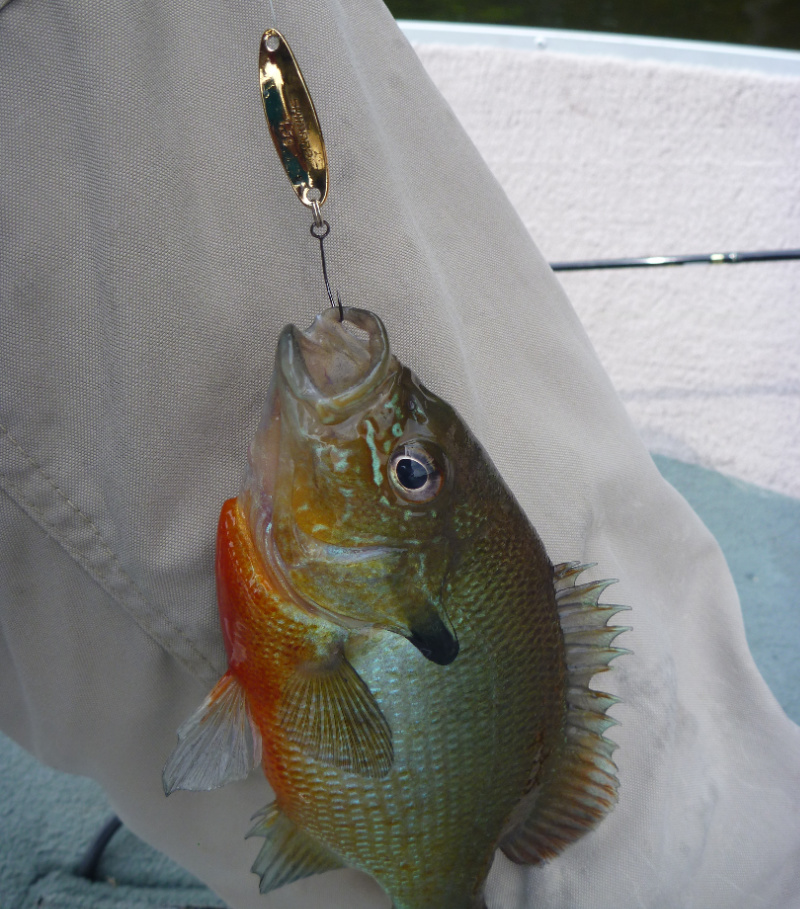 Red Breast Sunfish nailed this 1.5g Shimano Slim Swimmer
There is no question that on a small mountain stream, with rocks and eddies and overhanging tree branches, casting accuracy is of paramount importance. Generally, a trout is going to hit your lure on the first cast or not at all. However, if your cast is a bit too far away, he may just follow the lure without hitting it. If it's too close he'll just run for cover. In either case, a second cast is probably a waste of time. Dropping a lure into a small target, and doing so softly, is absolutely critical. There is no point having pinpoint accuracy if your lure lands with a big splash and scares the fish you were trying to catch.
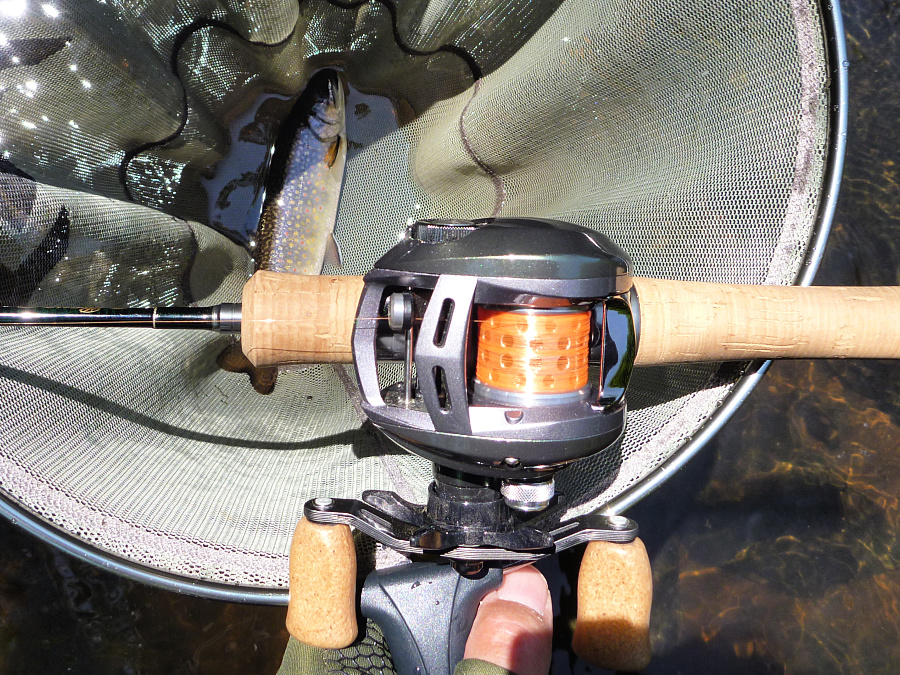 Small stream baitcaster brookie.
Ultralight BFS
I have to tell you, I was never a fan of baitcasters until I tried a BFS reel on an ultralight rod. Holy mackerel! I feel like I've seen the light - or perhaps, as my friend Mark L says - I've seen the dark side. I catch more fish with a tenkara rod than with a fly rod. I catch more fish with a spinning rod than with a tenkara rod. I catch just as many fish and have more fun with a baitcaster. I am absolutely sure that with more practice I will catch more fish - probably many more fish (and have more fun doing it). It is the sort of thing that you just have to try and see for yourself - then you'll ask yourself why you haven't fished this way all along.
So, why don't trout fishermen use baitcasters? The answer to that question is easy - up until now, no one has been talking or writing about fishing ultralight baitcasters for trout. However, now that you've read this far, that excuse is no longer valid. Give it a try. You will be amazed. And Mark will be happy to say "Welcome to the Dark Side."
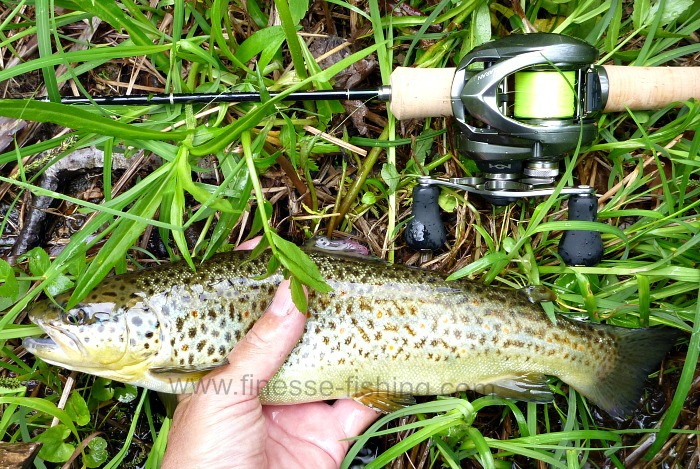 One of my first trout with a BFS reel and ultralight rod.
Finesse-Fishing Home > Bait Finesse System
Header photo: Tenryu Rayz RZ4102B-UL, Shimano Calcutta Conquest BFS-HG ('17)
Warning:
The hooks are sharp.
The coffee's hot.
The fish are slippery when wet.
All the hooks sold on Finesse-Fishing.com, whether packaged as loose hooks or attached to lures, are dangerously sharp. Some have barbs, which make removal from skin, eyes or clothing difficult. Wear eye protection. Wear a broad-brimmed hat. If you fish with or around children, bend down all hook barbs and make sure the children wear eye protection and broad-brimmed hats. Be aware of your back cast so no one gets hooked.
Also, all the rods sold on Finesse-Fishing.com will conduct electricity. Do not, under any circumstances, fish during a thunderstorm. Consider any fishing rod to be a lightning rod! Fishing rods can and do get hit by lightning!
Whatever you do, do it with finesse!