Finesse-Fishing Colorado Spinners
One of my earliest memories of fishing with my father was fishing a Colorado Spinner on either the Roaring Fork or the Frying Pan river in Colorado. That was over 60 years ago, so some details are a little foggy. I don't remember which river. I mostly fished flies and I don't remember which flies. I clearly remember catching fish on that Colorado Spinner, though. Finesse-Fishing Colorado Spinners are made the same way and can make the same lasting memories.
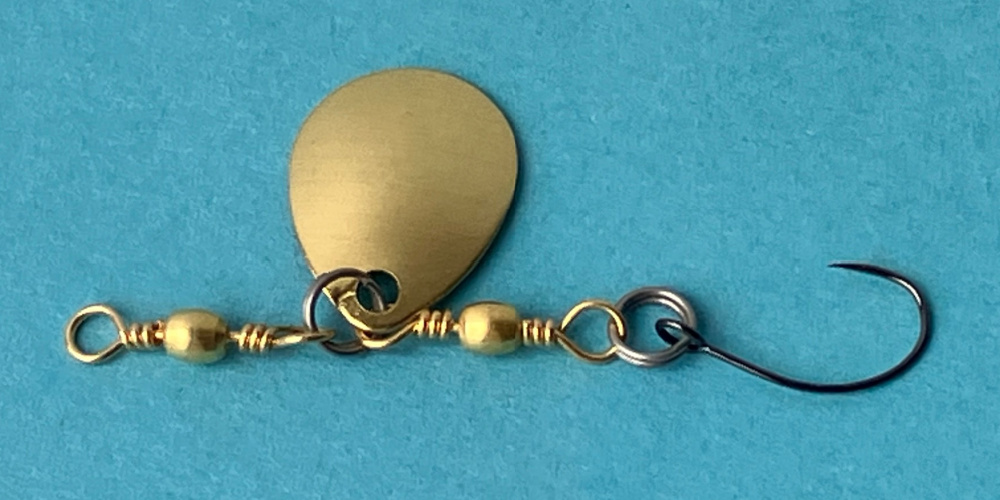 Colorado Spinner
Colorado Spinner blades are ubiquitous. The Colorado Spinner lure, though, is almost forgotten. The classic Colorado Spinner consists of a swivel, a Colorado Spinner blade, a second swivel and finally a hook. The parts are held together with two split rings.
Colorado Spinners have been catching fish for over 100 years! I have seen photos of vintage WTJ Lowe's "Star Colorado Spinners" that are said to have been made in the 1890s. WTJ Lowe was indeed selling spinners of various designs in the 1890s, but the cards to which the Star Colorado Spinners were attached do not show a date. W.T.J. Lowe's company was sold to Pfleuger in 1915, so unless Pfleuger continued to sell spinners under the WTJ Lowe's trademark, the Star Colorado Spinners are at least that old. (And I doubt they did. I've seen photos of Colorado Spinners that had Pflueger stamped on the blade.) The vintage Lowe's and Plfueger spinners clearly are Colorado Spinners, though, using the exact same construction as today.
If Colorado Spinners have been around for over 100 years and they still catch fish, why are they almost forgotten? I suspect it is because they are very light weight, and thus hard to cast very far. The original WTJ Lowe's spinners were designed for trolling, not casting, so a heavy weight was not needed. Currently, there are only three companies that I know of that sell classic Colorado Spinners.
Other companies sell inline spinners made with Colorado blades, which they incorrectly identify as Colorado Spinners. If a spinner is made with a wire shaft rather than a pair of swivels, it isn't a Colorado Spinner. Period. Finesse-Fishing Colorado Spinners follow the classic "recipe," a Colorado Spinner blade, two swivels, a hook and two split rings to hold it all together
Of the three companies that sell classic Colorado Spinners, two of them sell only very large ones with ungainly siwash hooks. The third sells Colorado Spinners with barbed treble hooks, but most of their spinners are also very large - much larger than you would want for trout fishing in streams. The reason these companies sell very large spinners must be because the only people who fish with Colorado Spinners these days are drift fishing for steelhead and salmon, fishing a spinner below a bobber. Finesse-Fishing Colorado Spinners come in the sizes you would want for trout or panfish or creek chubs. (Don't ignore creek chubs!)
I suspect the reason the Colorado Spinner has fallen out of favor is that most fishermen, even most fishermen who use "ultralight" rods, can't cast them very far. Of course, most fishermen using ultralight rods are using 4 or more likely 6 lb test line, in lakes, and somehow think they need to cast into the next county, or at least into the very middle of the lake. I mostly fish smaller streams (which don't even extend into the next county). In a small stream, a long cast might be 25 feet. Some are half that.
 Small brown trout caught on a Colorado Spinner. June 2017
I have fished Colorado Spinners for years. I could never buy the size I wanted so I made my own. There are dozens of YouTube videos on how to make your own spinners. As could be expected, virtually every single one is on how to make an inline spinner that looks a lot like a Mepps or a Rooster Tail. I think I've seen exactly one that showed how to make a real Colorado Spinner - and sure enough it was huge - the size you'd want for steelhead or salmon.
 A few micro spoons and a few more Colorado Spinners. Size 00 in the upper right corner. The two bottom ones are size 1 (although with different sized swivels). The rest are size 0.
I pretty much stopped fishing Colorado Spinners once I started importing the Smith Niakis and AR-S spinners. After all, I always wanted new photos for the website so why take the chance of catching a stunning fish on a lure I couldn't showcase on the site. Crass commercialism? Perhaps, but the bills do need to get paid, you know.
What reawakened my interest in Colorado Spinners was seeing a Japanese YouTube video on chubbing. That definitely caught my eye, in that a lot of the thrust of both the TenkaraBum and Finesse-Fishing websites has always been fishing where and how others don't. No one in the US fishes for chubs. They catch chubs while fishing for something else. Fishing specifically for chubs opens up a whole new ballgame.
That also was only a little while before my annual trip to Maine where a friend and I fish for smallmouth bass. Well, the lake where we fish is full of redbreast sunfish. Chubs have small mouths. Sunfish have small mouths. Lures that work for sunfish ought to work for chubs, too. Rather than take a chance of losing my few remaining AR-S spinners among the rocks, I went through my bag of old, unused lures and pulled out some Colorado Spinners, which I thought ought to be small enough for sunfish to take easily.
They were indeed small enough. The sunfish wouldn't leave them alone. Even a few of the nicer bass decided to get in on the act. Whether fishing from the boat and casting towards shore or standing on shore and casting into the lake, I was able to cast all of the Colorado Spinners I had brought far enough to catch fish.
 Smallmouth bass caught on one of the size 1 Colorado Spinners shown in the box of spinners above. The rod is a Tenru Rayz Alter RZA5102S-LLT.
However, (and it is a big however) the rod I used, a Tenryu Rayz Alter RZA5102S-LLT was designed for fishing "Areas" in Japan (private, heavily stocked, heavily pressured, pay-to-fish lakes). Because the Areas get lots of fishing pressure, anglers use very thin lines and very small lures, primarily micro spoons that weigh anywhere from .5 to 1.5 grams. The Colorado Spinner the bass hit weighed a bit over a gram. The rod cast it easily.
The small trout caught on a Colorado Spinner, shown a bit higher on the page, was caught with a Daiwa Iprimi 56XXUL-S, another rod designed for fishing Areas. I was using 2.5 lb line at the time, which is the maximum strength recommended for the rod. The Colorado Spinner in the photo looks like a size 1, which would have weighed about 1.25 gram, well above the rod's .4g minimum rating.
 Creek chub caught with Colorado Spinner
The creek chub above was caught with what I think was a size 1 Colorado Spinner, which would have weighed about 1.25 gram. The rod was not an Area rod, but was a rod designed for use in very small streams. It is rated for lures as light as 1 gram. I couldn't cast the spinner far but clearly it was far enough.
If you have a rod rated for lures of a gram or less, and are fishing with 2 lb line, you could cast a size 1 Colorado Spinner as far as you need to. In smaller streams, you should be able to cast a size 0, which will weigh 1 gram. Not far, but probably far enough. And speaking of line, use Japanese 2 lb line. The 2 lb line readily available in the US isn't really 2 lb line. It is thicker, stiffer and stronger.
Seriously, compare the diameters of various lines labeled as 2 lb. Suntech Area Meister 2 lb line is .104mm. Trilene XL is .12mm. Trout Magnet "2 lb" line is .16mm (which is thicker than the Area Meister 4 lb line)! Anglers who are impressed with a certain "2 lb" line because it is strong are really fishing a 3 lb or 4 lb line. To cast really light lures, use an honest 2 lb line. You're never going to catch a 2 lb chub or a 2 lb sunfish. You might catch a 2 lb trout, but if your reel has a good drag, 2 lb line is plenty strong enough.
Finesse-Fishing Colorado Spinners
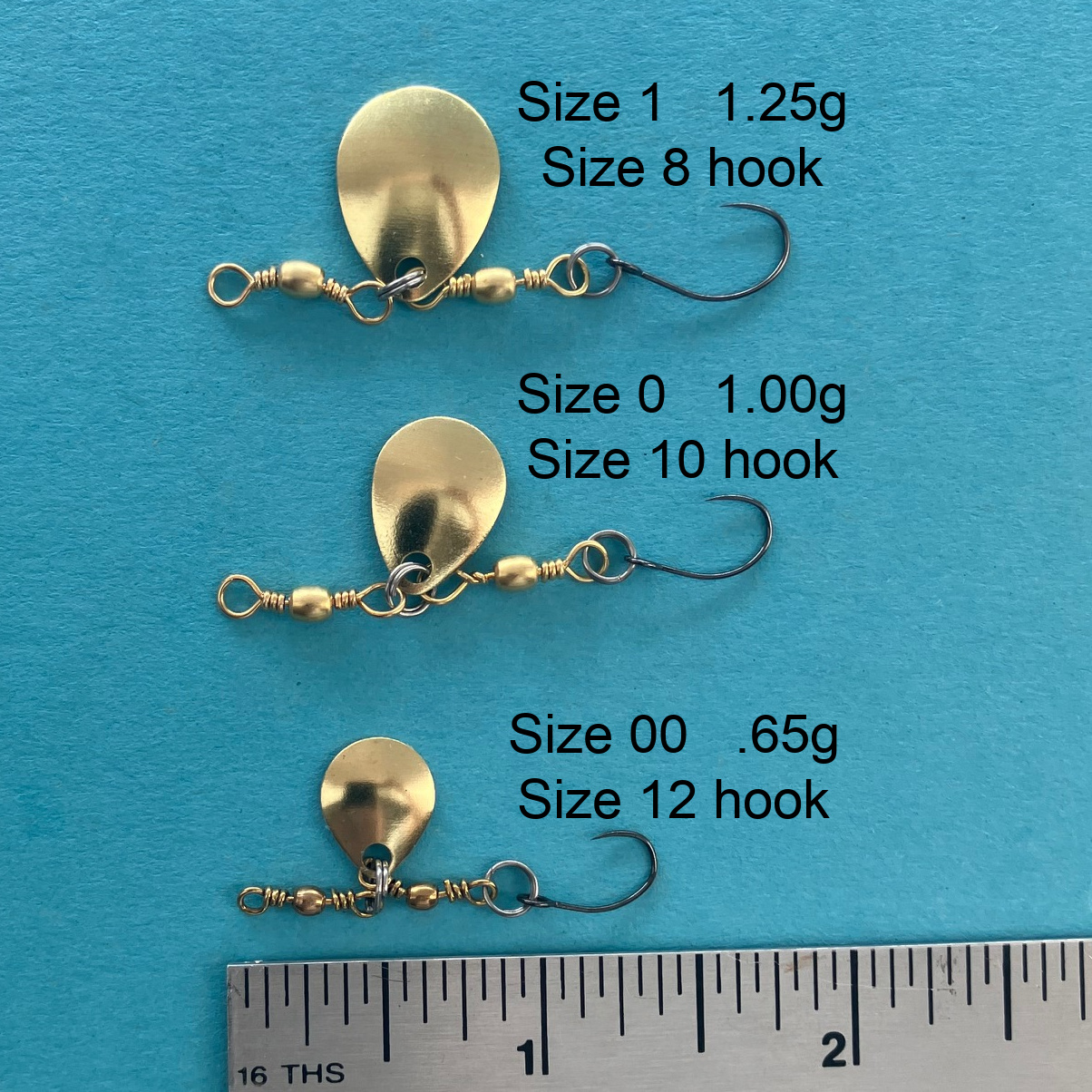 Finesse-Fishing Colorado Spinners: sizes and specifications.
For each size the Black/Gold version is .05g lighter.
(The dark spots are reflections.)
The gold colored size 1 spinners weigh 1.25 grams, with a blade a little under 3/4" long by a little over 1/2" wide. The overall length is about 2". They're small enough for chubs, small enough for sunfish, small enough for little wild brookies, and large enough to interest a 2 lb bass. They are heavy enough to cast with an ultralight rod and 2 lb line.
The gold colored size 0 spinners weigh 1 gram, with a blade not quite 5/8" long by about 7/16" wide. They are about 1 7/8" long. At one gram, you should be able to cast them with an ultralight rod and 2 lb line. They won't cast far, but I've been able to cast them far enough to catch fish.
Please understand that the gold colored spinners aren't really gold (not at this price!). The gold colored spinner blades are lacquered brass.
 Small brown caught with a size 00 Colorado Spinner.
The gold colored size 00 spinners are mostly a test to see if anyone can cast them far enough to catch fish. They weigh .65 gram, more than some of the micro spoons I used to import. A lot of people caught a lot of trout and sunfish with the micro spoons. The overall length is about 1 1/2". The blade is about 3/8" wide and 7/16" long.
I didn't have many in stock, in any of the three sizes. It really was a test to see if people wanted extremely light lures - ultra finesse lures for ultra light rods. I'll make a few more once I get the necessary components. As long as the Finesse-Fishing Colorado Spinners keep selling out I'll keep making more.
Be careful with the hooks. They are extremely sharp and because of the split ring and swivel attachment, they are incredibly "sticky." Bring clamps or hemostats to unhook fish.
One other thing - you won't find size 0 or 00 Colorado Spinners anywhere else.
If the button says Add to cart the item is in stock.
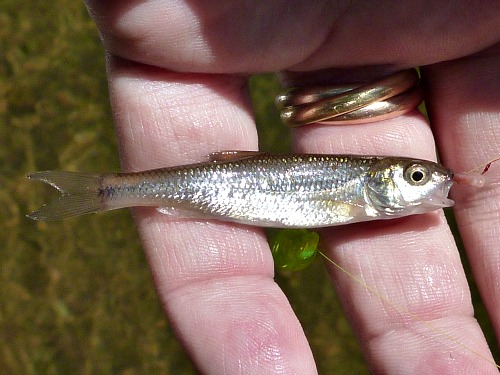
When I was mostly fishing spoons, I discovered that a nickel (silver colored) spoon did much better than a gold one on a stream that had a large population of immature fallfish, which are very silvery.
Depending on where you fish, you might want to have a nickel plated (silvery) spinner in addition to a gold colored one.
Just one in stock.
If the button says Add to cart the item is in stock.
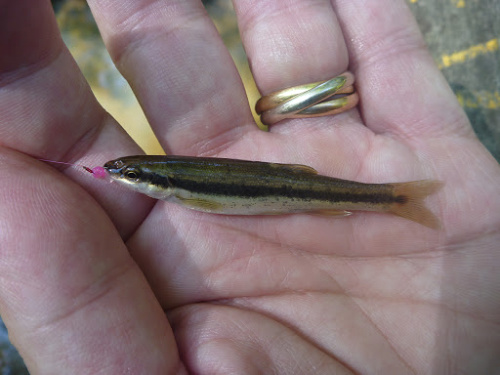 Blacknose Dace
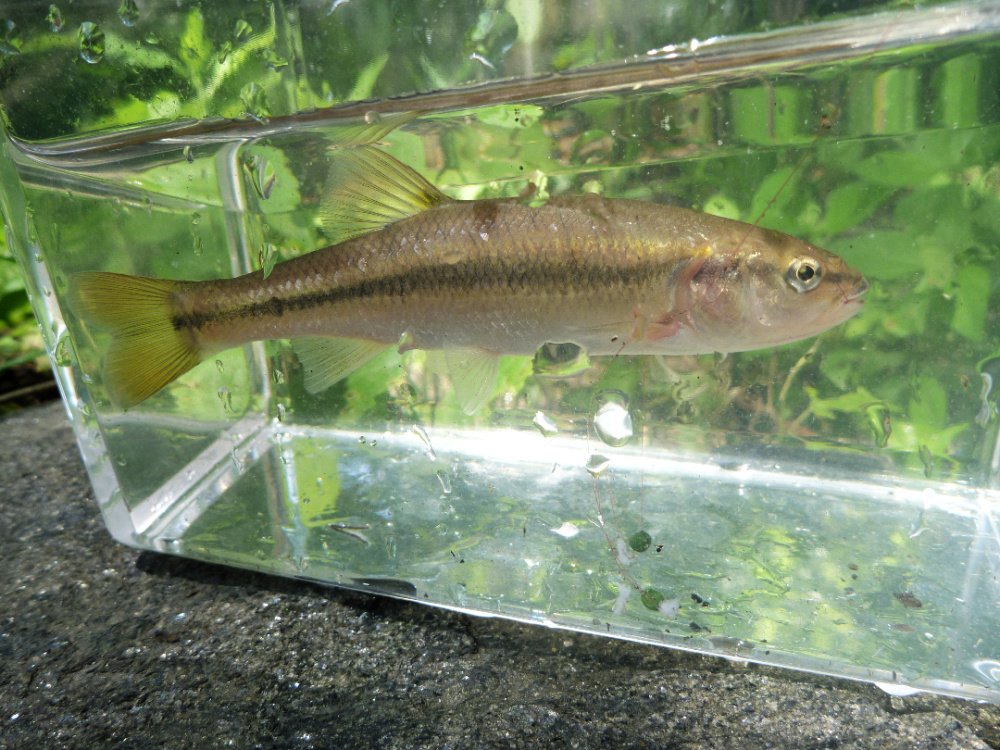 Juvenile Creek Chub
I have often wondered why there are no trout lures that have the color pattern found in many of the minnows that trout eat - a prominent black stripe along the side from mouth to tail. The most well known may be the Blacknose Dace but there are numerous others.
Well, that is pretty easy to mimic with a Colorado Spinner. Instead of using the standard gold colored swivels use black swivels. The black swivels are slightly smaller than the gold colored ones, so the resulting lure weight for the size 1 Colorado Spinner is 1.2g. For the size 0 the weight is .95g, and for the size 00 the weight is .6g. Each is .05g lighter than the Gold colored Colorado Spinners.
If the button says Add to cart the item is in stock.
The spinner blade and the hook on the Black/Gold size 00 look like they are larger than on the Gold size 00, but they are exactly the same size on both spinners. The Black/Gold photo ended up being more of a close-up shot.
And just in case you need some real 2 lb line, the Sunline Area Meister 2 lb line is a good choice. With alternating fluorescent orange and smoke gray sections, you can watch your line without alerting the fish.
100 meter spool
.104mm diameter
Only two spools left in stock (if the button says Add to cart).
Shipping
Shipping is $7 for packages that weigh up to 8 ounces, and $8 for packages that weigh over 8 ounces.
Finesse-Fishing.com no longer ships anywhere outside of the US.
Finesse-Fishing Home > Single Hook Lures > Finesse-Fishing Colorado Spinners
Header photo: Tenryu Rayz RZ4102B-UL, Shimano Calcutta Conquest BFS-HG ('17)
Warning:
The hooks are sharp.
The coffee's hot.
The fish are slippery when wet.
All the hooks sold on Finesse-Fishing.com, whether packaged as loose hooks or attached to lures, are dangerously sharp. Some have barbs, which make removal from skin, eyes or clothing difficult. Wear eye protection. Wear a broad-brimmed hat. If you fish with or around children, bend down all hook barbs and make sure the children wear eye protection and broad-brimmed hats. Be aware of your back cast so no one gets hooked.
Also, all the rods sold on Finesse-Fishing.com will conduct electricity. Do not, under any circumstances, fish during a thunderstorm. Consider any fishing rod to be a lightning rod! Fishing rods can and do get hit by lightning!
Whatever you do, do it with finesse!