Trip Report - 9-15-19
Following last year's trip to Japan I wrote an article on Sinking Minnow Lures, explaining that they are the most popular lure for stream fishing in Japan. On Sunday, I realized that you might want a few floating minnow lures as well.
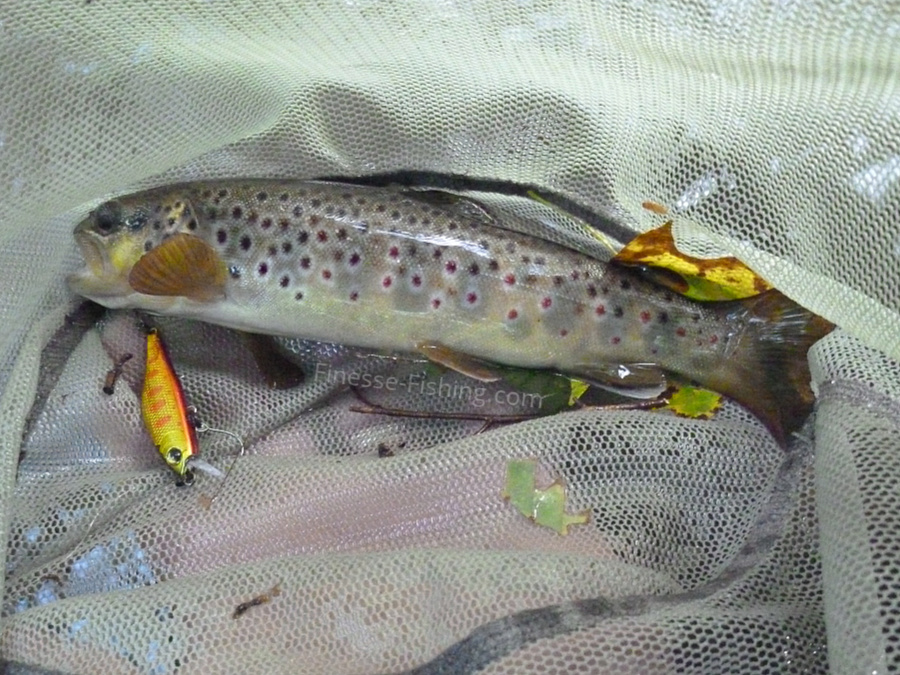 Daiwa Silver Creek Red Gold Yamame 44S
I spent the day fishing with Daiwa Silver Creek Minnows on which I had replaced the factory treble hooks with Cultiva S-55M single hooks.
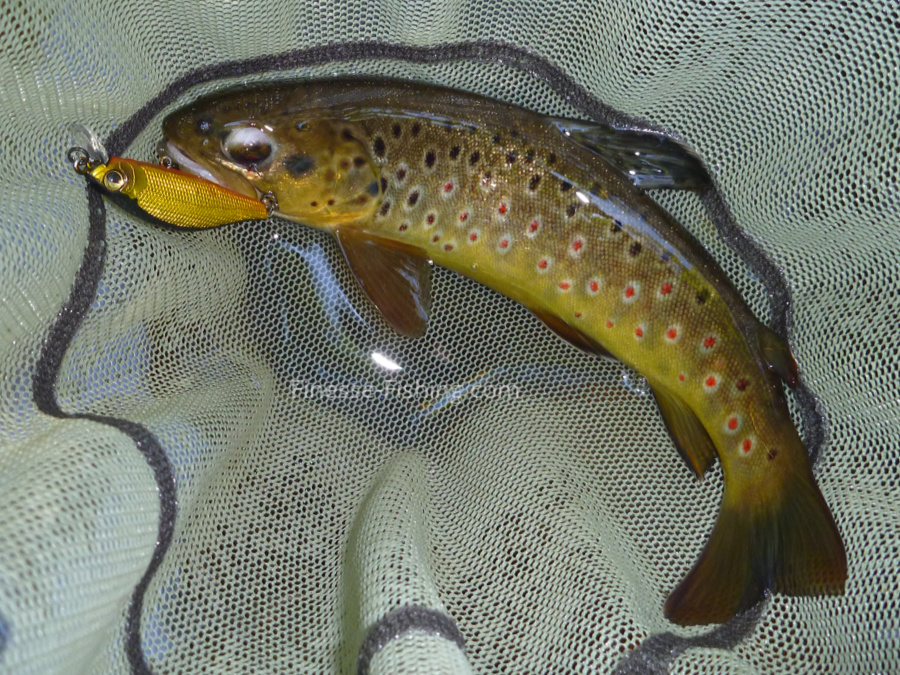 Daiwa Silver Creek Black Gold 50S
The plugs worked as advertised, and I caught more than a few fish with each of the two colors.
Unfortunately,
I also caught a lot of moss. The stream I fished is neither
particularly large nor particularly deep. It is, however, strewn with
large rocks, making it particularly hard to fish a sinking minnow lure.
On a high percentage of my casts, the lure would slide over a rock and come back with moss on the bill.
 With this many rocks above the surface
 imagine how many are just below the surface.
The lures are not deep divers, but if there is a rock in the lure's path on the retrieve it cannot be avoided (even if you can see it, which if you are casting any distance you can't unless the water is very clear and the light is just right). I remember a comment from John Vetterli (a tenkara guide who spin fishes in his spare time) about fishing a floating minnow in a snag-filled stream. He said if there is a sunken log or branch just stop reeling and the lure will float to the surface and come right over it. I definitely could have used that on Sunday!
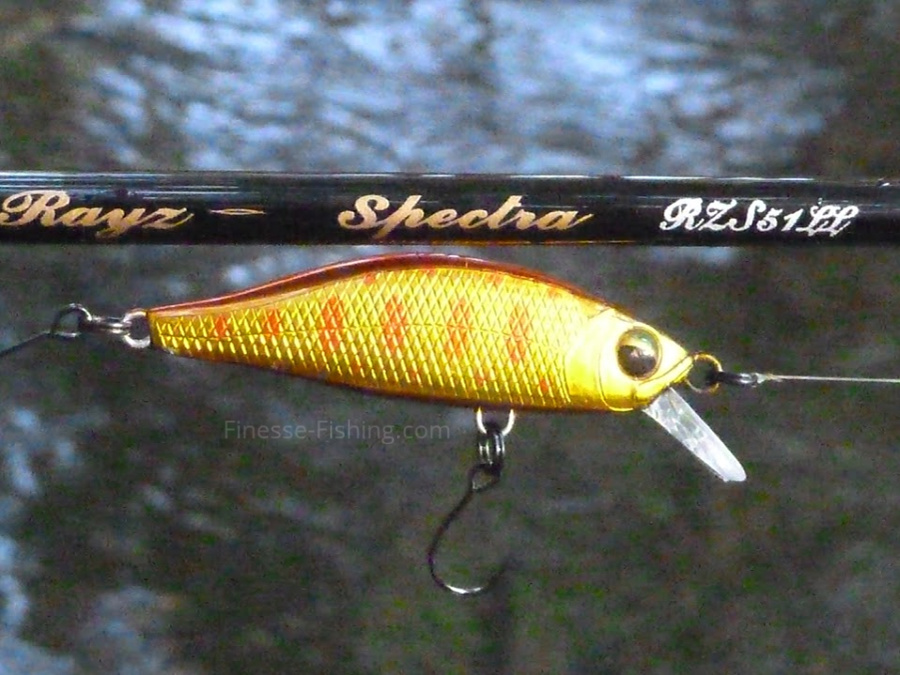 Daiwa Silver Creek Red Gold Yamame 44S
The photo above shows the front hook positioned so the point is facing forwards. I had read some on-line comments expressing concern that a hook rigged that way would lead to more snags and lost lures. I did not have any problem with that on Sunday. I think the bill hits first and the position of the tie-in above the bill causes the back end of the lure to raise up when the bill hits something. That seems to raise the front hook above whatever the bill hit. When the lure then slides over the rock, the hook doesn't catch. (The bill still comes back with moss, though.)
However, I did have frequent problems of the front hook catching the line, which causes the lure to spin on the retrieve. Needless to say, I got no hits when the lure was spinning like a windmill. I did not try changing the orientation of the hook so see if a backward pointing hook also caught the line, but I did get frustrated enough that I just removed the front hook partway through the day. Up until that point, only one fish had been caught on the front hook and there is no telling how many fish I might have caught had the front hook not ruined the retrieve.
Next time I'm out, I will try the same lures with the same hooks but with the front hook positioned so that the point faces backwards.
I'll also order some floating minnow lures.
Update: Since writing this page I have seen a YouTube video in which a Japanese angler explained that "feathering" your cast when fishing a spinning rod on a mountain stream is very important. Feathering is positioning your index finger near the rim of the spool so that the line streaming from the spool during a cast lightly brushes against your finger. At any point, you can stop the cast by pressing your finger against the rim, preventing any more line from going out (which I knew). What I hadn't realized is that by continuously feathering the line, you keep the line tight from the reel all the way to the lure. As the lure reaches your target you stop the cast. The line, still tight, never has a chance to foul the front hook on the lure.
Many of the fish I have caught on minnow lures were caught on the front hook. I now think that the best practice is to keep both single hooks, orient the front one so that the point faces forward and feather the line so that the front hook doesn't catch the line. Plus, of course, feathering the line allows you to stop the lure's flight before it overshoots your target and gets snagged in the foliage on the far bank. Dropping a lure right next to the bank or a log will almost certainly yield more strikes, but you have to be able to stop the lure's flight instantaneously. You need to know how to feather your cast.
Header photo: Tenryu Rayz RZ4102B-UL, Shimano Calcutta Conquest BFS-HG ('17)
Warning:
The hooks are sharp.
The coffee's hot.
The fish are slippery when wet.
All the hooks sold on Finesse-Fishing.com, whether packaged as loose hooks or attached to lures, are dangerously sharp. Some have barbs, which make removal from skin, eyes or clothing difficult. Wear eye protection. Wear a broad-brimmed hat. If you fish with or around children, bend down all hook barbs and make sure the children wear eye protection and broad-brimmed hats. Be aware of your back cast so no one gets hooked.
Also, all the rods sold on Finesse-Fishing.com will conduct electricity. Do not, under any circumstances, fish during a thunderstorm. Consider any fishing rod to be a lightning rod! Fishing rods can and do get hit by lightning!
Whatever you do, do it with finesse!